
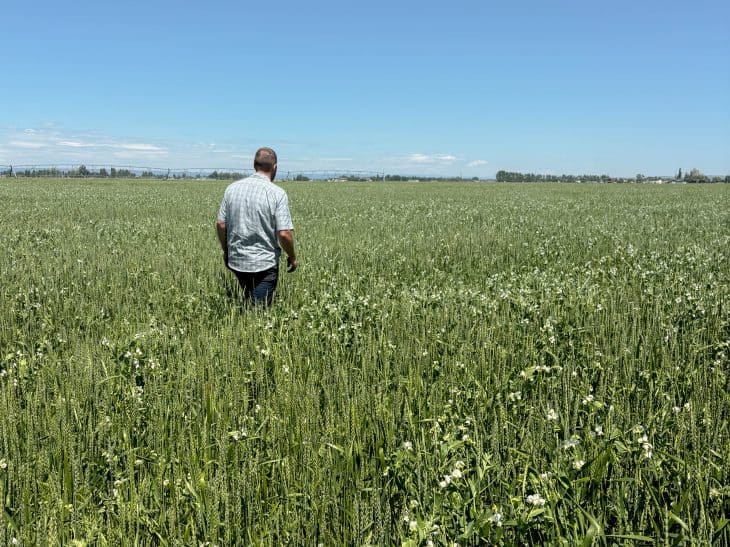
Right now, if you walked out into our spelt wheat fields, you’d see more than just spelt. You’d see peas. You’d see radish. In a few fields, you’d see think red clover growing right alongside the grain. None of that is by accident.
We have several fields of spelt this year, and each one has something different going on. But the principle running through all of them is the same: companion cropping. We plant different species together to build biodiversity in the field. Different plants attract different biology, different bugs, different nutrients. Each one brings something the soil needs.
Why Companion Cropping Matters on Our Farm
In regenerative organic farming, we’re not just growing a single crop in a monoculture. We’re stewarding an entire ecosystem working inside God’s design for healthy and delicious foods. Clover and peas (legumes) fix nitrogen from the air into the soil, eliminating the need for synthetic inputs. Radishes act as natural soil aerators with their deep taproots, breaking up compaction and scavenging nutrients. All of this supports the microbial life that makes our ancient grains thrive, leading to healthier soil, better nutrient density in the harvest, and ultimately more flavorful, digestible food for your table.
Peas, Nitrogen, and a Discovery We Made by Accident
In a few of our spelt fields this year, we’re growing Austrian winter peas right alongside the grain. They’re a tough variety. They survive winters, then come up in spring and grow tall and thick — shoulder height by the time the spelt is established beside them. While they’re growing, they’re quietly doing some of the most important work in the field.
Peas attract a bacteria that can pull nitrogen right out of the air. The air is about 15% nitrogen, and that bacteria brings it down to the roots and makes it available to the plant. The pea stores that nitrogen inside itself and in nodules on its roots. When the plant dies, it becomes food for the grain. That’s the nutrient cycle we’re always working toward. What we plant this year is really for next year’s crop.
Here’s the part we didn’t expect. We noticed that fields with peas growing regularly had far fewer wild oats the following year. We stumbled onto that one by accident, but it turned out to be a wonderful discovery on our farm.
That actually connects to something we’ve come to believe pretty deeply: weeds are talking to you. There’s a book called When Weeds Talk that puts it simply. Most people see a weed and ask, “how do I kill it?” But a weed that’s taking a hold on a field means something in the soil isn’t right. It’s a message. The question isn’t how to kill the weed, it’s what the soil is asking for. Peas, it turns out, answers that question for wild oats. We didn’t plan it that way at first. We just noticed it, year after year, and now we plant for it.
A Blanket of Crimson Clover, Two Years in the Making
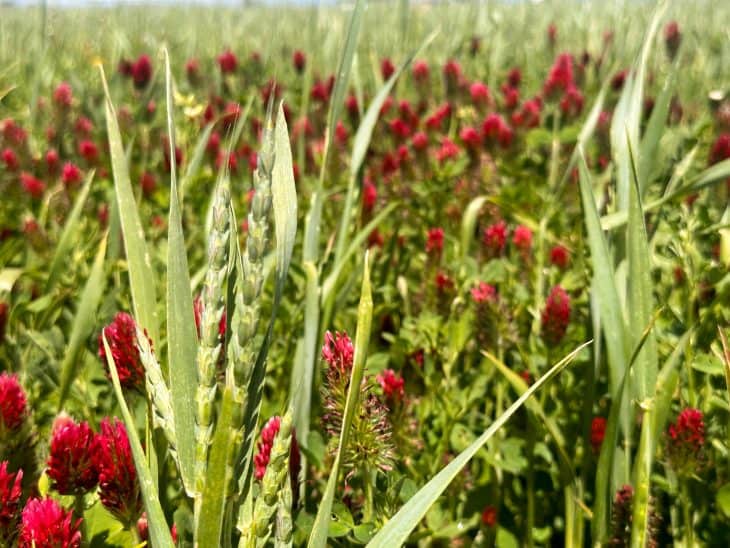
One of our spelt fields right now has crimson clover growing right alongside it, and this spring it bloomed into a beautiful red blanket across the whole field. That clover didn’t get planted this year. It went to seed back in 2024, fell to the ground on its own, and then last fall we watered it up and planted spelt right into it. It grew alongside the spelt all winter, and now here we are in 2026 looking at the bloom.
Even the benefit isn’t fully here yet. What we’re seeing this year is going to help the 2027 crop even more than this one. That’s how a lot of this works. You’re not just farming for this season. You’re farming for the one after it, and the one after that.
Radish, Calcium, and What’s Hiding Below the Surface
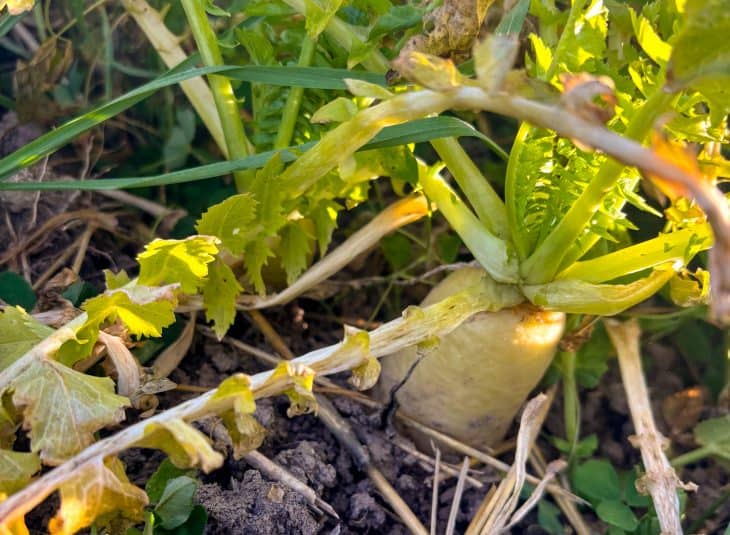
Last winter we planted a lot of daikon radish into our grain fields, and this spring we did it again in several fields. Daikon doesn’t survive the winter. It drives a deep spike down into the ground, then dies when it gets too cold and starts to decay.
That decaying radish is full of calcium, and calcium is the heaviest element in the soil, which means it naturally sinks toward the bottom over time. The radish root pulls some of that calcium back up. The biology in the soil follows it, gathers it, and makes it available to the next crop. If you walked through one of our fields right now, you might see radish growing right alongside the grain, and maybe clover too.
Why We Plant What We Plant Together
Part of this comes down to canopy. A tall crop needs a companion that won’t compete with it for sunlight. Radish works well because even though it drives deep underground, it can also grow tall enough to still catch the light next to a tall grain. Crimson clover is the opposite. It never gets above knee height, so it has to be paired with something shorter, or we have to thin the grain so enough sun reaches down to it.
That’s exactly what we did in our clover field this year. We reduced the spelt population on purpose, so the sun could still reach the clover and the alfalfa growing underneath it. It looks like a thinner stand of grain if you don’t know why, but it’s intentional.
The Part Most People Never See: Separating It All at Harvest
If you’re growing this way and taking your crop to a regular elevator, they might reject it outright because it’s mixed with peas, clover, or radish. That’s one reason most farms don’t have a companion crop at this scale. We can, because we clean and process every bit of our own grain right here.
Wheat and peas are actually one of the hardest combinations to separate, because they’re such a similar density. But spelt and einkorn stay inside their hull right off the combine, which makes them much lighter than they’ll be once hulled. We separate the peas out while the grain is still in the hull, and only after that do we de-hull the spelt or einkorn. We decide what to plant together based on how we know we’ll be able to separate it later. Being able to farm this way and clean it ourselves into a good final product, that’s really the core of what makes this whole approach work for us.
See It for Yourself
We put together a short video walking through these same companion crop fields this season. You can see the clover, the radish, and the peas for yourself, right where they’re growing.
We’re grateful to be able to farm as we do, for the lessons we’ve learned this year, and for the chance to keep learning how to take care of it a little better with every season.
Shop Our Spelt Products
Checkout our full selection of organic spelt products:
Organic Spelt Berries in Paper Bags
Organic Spelt Berries in Pails for Long-Term Storage
Organic Spelt Flour (coming soon)
